
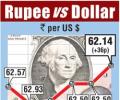
The rupee has fallen 0.8 per cent so far this year, hitting a one-month low on Friday, hurt by a stronger dollar globally as well as caution ahead of key economic data this month.
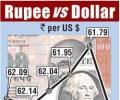
The partially convertible rupee closed at 62.16/17 per dollar compared to 61.79/80 on Tuesday. Financial markets were closed on Wednesday for Christmas.

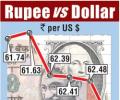
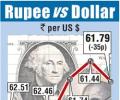
The partially convertible rupee closed at 61.79/80 per dollar on Tuesday compared with 61.9525/9625 on Monday. The unit rose to 61.78 during the session, its highest since December 18.
.jpg)
The rupee resumed slightly lower at 62.05 per dollar as against the last weekend's level of 62.04 at the Interbank Foreign Exchange market. It recovered to 61.88 per dollar before quoting 61.93 at 1045 hours.
In Singapore, oil prices eased in Asian trade today on a mixed US inventory report indicating tepid demand, while expectations of a return of Libyan supplies also weighed, analysts said.

Traders are now focussed on the upcoming November trade data, due sometime this week, for near-term direction, with consumer inflation data due out on Thursday, which will help set expectations ahead of the Reserve Bank of India's policy review on December 18.
Traders said good dollar demand from importers including oil companies was seen at stronger rupee levels, limiting any further gains.
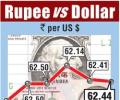
The domestic currency resumed higher at 62.30 per dollar as against the last closing level of 62.41 at the Interbank Foreign Exchange Market and firmed up further to 62.20 a dollar.
.jpg)
Most Asian currencies weakened versus the dollar with the Thai baht and Philipine peso sliding on disappointing economic data.
The concessional swap windows have attracted about $25 billion, RBI deputy governor HR Khan said on Monday.

Most immediately, he pledged to move slowly if needed in winding down an oil window that provides dollars directly to state-run oil companies
The previous bout of Fed withdrawal fears had threatened to spark a crisis of confidence in India -- sending the rupee to a record low of 68.85 in late August and leading to steep falls in bonds and stocks.

S&P is the only of the three major credit agencies with a 'negative' outlook on India.
The rupee which has been relatively stable over the last couple of months after having seen as much as 20 percent fall to a record low in late August has been boosted mainly by robust foreign fund inflows into the stock market.

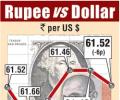
The partially convertible rupee closed at 61.2350/2450 per dollar compared with 61.31/32 on Tuesday.
The RBI's macroeconomic report released after the close of markets said upside risks to food inflation remain and that it expects the retail and wholesale price inflation to remain above comfort levels.
.jpg)
The plan being negotiated by US Senate leaders would end a partial government shutdown and raise the debt ceiling by enough to cover the nation's borrowing needs at least through mid-February 2014, a source familiar with the negotiations told Reuters.

The rupee resumed lower at 61.15 per dollar as against the last weekend's level of 61.07 at the Interbank Foreign Exchange market and hovered in the range of 61.15 and 61.28 before quoting at 61.24 per dollar at 1030 hours.
.jpg)
Sentiments turned buoyant after RBI on Monday cut the marginal standing facility rate, at which it lends emergency funds to banks, by 0.5 per cent to 9 per cent with an aim to improve liquidity and boost economic activities.
Traders say the rupee and other global currencies will likely track the continued uncertainty in the US budget stalemate and government shutdown.
